
Abstract: Transportation sources are a major contributor to air pollution in urban areas, and the role of air quality modeling is vital in the formulation of air pollution control and management strategies. Many models have appeared in the literature to estimate near-field ground level concentrations from mobile sources moving on a highway. However, current models do not account explicitly for the effect of wind shear (magnitude) near the ground while computing the ground level concentrations near highways from mobile sources. This study presents an analytical model (SLINE 1.0) based on the solution of the convective–diffusion equation by incorporating the wind shear near the ground for gaseous pollutants. The dispersion coefficients for stable and unstable atmospheric conditions are based on the near-field parameterization. Initial vertical dispersion coefficient due to the wake effect of mobile sources is incorporated based on a literature review. The model inputs include emission factor, wind speed, wind direction, turbulence parameters, and terrain features. The model is evaluated based on the Idaho Falls field study (2008). The performance of the model is evaluated using several statistical parameters. Results indicate that the model performs well against this dataset in predicting concentrations under both the stable and unstable atmospheric conditions. The sensitivity of the model to compute ground-level concentrations for different inputs is presented for three different downwind distances. In general, the model shows Type III sensitivity (i.e., the errors in the input will show a corresponding change in the computed ground level concentrations) for most of the input variables using the ASTM (American Society for Testing and Materials) method. However, some recalibration of the model constants is needed using several field datasets to make sure that the model is acceptable for computing ground-level concentrations in engineering applications.

Prototype of Eco-Friendly Indoor Air Purifier to Reduce Concentrations of CO2, SO2 and NO2
Urbanization and industrialization lead to the increased usage of fossil fuels for running various types of automobiles and industries in developing countries. The rapid growth of automobiles usage in major cities causes air pollution and its direct impact on public health. This impact is alarming the worsening of the health of urban dwellers. But this impact can be reduced by breathing the filtered air. Filtering of air can be done in multiple ways. Among all, filters prepared from natural materials have become popular. In this study, an attempt has been made to find the novel approach to reduce the pollutants’ level in the air by preparing prototype indoor air purifier which is designed, fabricated
and tested with eco-friendly materials and adsorbents prepared from plant extractions. The three pollutants considered were CO2, SO2, and NO2. Activated carbon was used as an adsorbent for CO2 and NO2 removal, whereas Neem bark, Mango bark, Orange peel powder and Neem leaf powder were used for SO2 removal. The prototype was designed for Hyderabad city, Telangana State of India and tested at houses of five different locations (Balanagar, Jeedimetla, Zoo Park, MGBS and JNTU) which are major traffic intersections in the city. The level of pollution before and after the installation of the instrument was measured for three months (January, February, March) and analysed. Results indicate the improvement of air quality after filtration.

Synthetic Wastewater Treatment using Agro-Based Adsorbents
This study was undertaken to determine the treatment a binary mixture of dye wastewater (containing Naphthol Green B) and the sugar industry wastewater for removal of color. The specific treatment in the current research consists of adsorption using low-cost adsorbents and microfiltration using Whatman-41 microfilters. Considerations of this treatment process are to take the samples using batch adsorption and avoid coagulation with further dilution. Numerous runs are made, with the ideal waste samples prepared in the laboratory. As a 1st step in the study, different dye concentrations are considered using different concentrations of sugar wastewater. Samples are treated with 3 different Agro-based low-cost adsorbents (orange peel, peanut hull, and Powdered Activated Carbon (PAC)). Transmittance values for Naphthol Green B after treatment with orange peel and peanut hull are 83.12 % and 76.98 % respectively. Peanut hull has the highest transmittance of 76.98 % with < 425 µm size. Orange peel contributes to the highest transmittance of 83.12 % with a 2 g dosage. The values of transmittance after treatment with PAC are taken as the datum for the comparison of adsorption performance after treatment using orange peel and peanut hull. Peanut hull has the highest Non-Purgeable Organic Carbon (NPOC) measurement of 37.86 mg/L when mixed with 600 ppm of sugar wastewater. Similarly, when mixed with 600 ppm of sugar wastewater, orange peel contributes to the NPOC value of 35.06 mg/L. These treated samples using low-cost adsorbents can be considered as pre-treated wastewater that can be sent to municipal wastewater treatment plants..

Treatment of Acid Orange 74 Wastewater and Sugar Wastewater by Low Cost Adsorbents
This study shows the treatment of combined binary mixture of Acid Orange 74 and sugar wastewater with peanut hull and orange peel as low-cost adsorbents. The performance of a combined adsorption-microfiltration process for the color removal is measured and compared using transmittance and absorbance indices at mechanical shaker mix level. This selected treatment procedure is among one of the most economical treatment alternatives to all technologies present now. The parameters studied during this research are analyzed using Langmuir and Freundlich isotherm models on low cost adsorbents. Conclusive results after the treatment are indicated in this paper at their optimum dosages and sizes. This treatment method is applicable in the actual conditions at territory treatment stage.
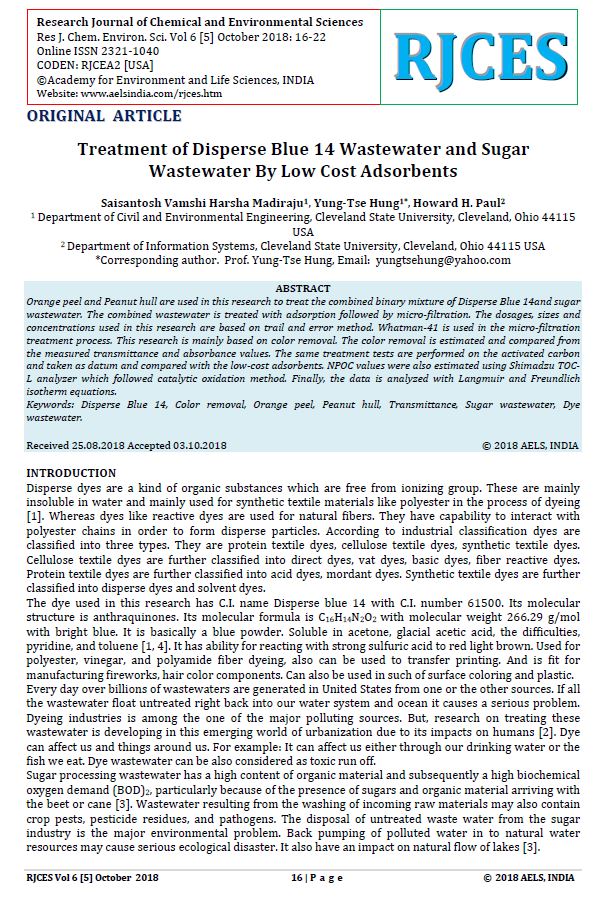
Treatment of Disperse Blue 14 Wastewater and Sugar
Wastewater By Low Cost Adsorbents
Orange peel and Peanut hull are used in this research to treat the combined binary mixture of Disperse Blue 14and sugar wastewater. The combined wastewater is treated with adsorption followed by micro-filtration. The dosages, sizes and concentrations used in this research are based on trail and error method. Whatman-41 is used in the micro-filtration treatment process. This research is mainly based on color removal. The color removal is estimated and compared from the measured transmittance and absorbance values. The same treatment tests are performed on the activated carbon and taken as datum and compared with the low-cost adsorbents. NPOC values were also estimated using Shimadzu TOCL analyzer which followed catalytic oxidation method. Finally, the data is analyzed with Langmuir and Freundlich isotherm equations.
Want to contact me for future Journal publications?
Thank you for your response. ✨

 Madiraju's Portfolio